

Banu YAKUBOVA
On July 16, 2026, a signing ceremony was held in Shanghai for the agreement establishing the World Artificial Intelligence Cooperation Organization (WAICO). Representatives from 29 countries, including Wang Yi, Member of the Political Bureau of the Central Committee of the Communist Party of China and Minister of Foreign Affairs, signed the agreement. The Shanghai-based organization’s core objectives include expanding international cooperation in the field of artificial intelligence and creating safe and equitable AI systems for the benefit of all humanity.[i]
Immediately following the signing ceremony, the World Artificial Intelligence Conference (WAIC) and the High-Level Meeting on Global Governance of Artificial Intelligence were held in Shanghai from July 17-20, 2026. At the opening of the conference, Chinese President Xi Jinping put forward the principles of “human-centered, artificial intelligence for good and progress.” Xi also announced that within the next five years, five thousand training and exchange programs would be provided to create fair and rational artificial intelligence systems in developing countries, and that joint cooperation centers would be established with the Association of Southeast Asian Nations (ASEAN), the African Union, the Community of Latin American and Caribbean States (CELAC), BRICS, and the Shanghai Cooperation Organization (SCO).[ii]
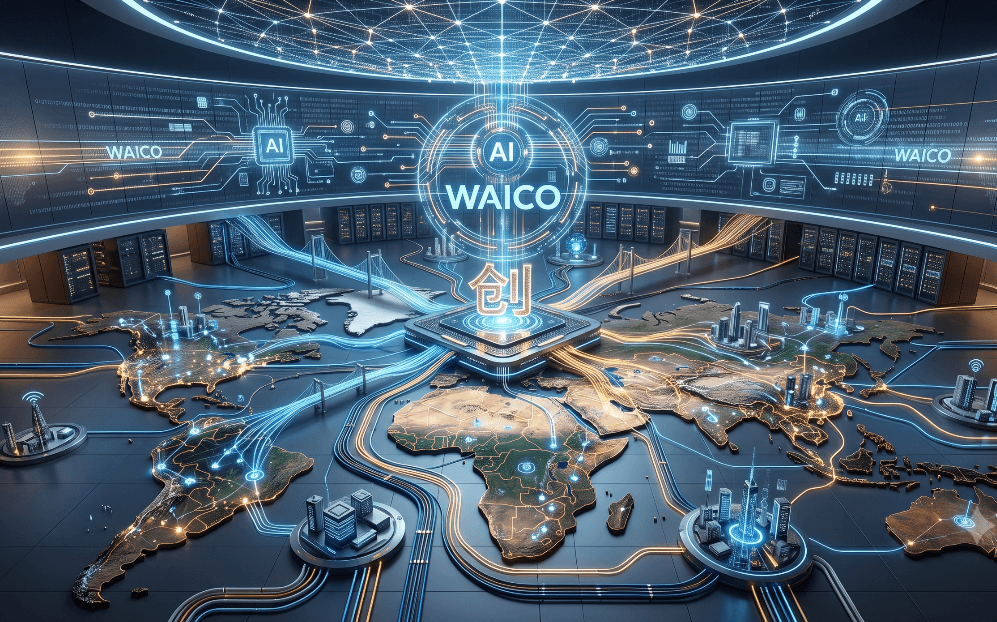
In this context, WAICO reflects China’s pursuit of institutional cooperation aimed at enhancing the capacity of developing countries, particularly those in the Global South, in the field of artificial intelligence. Today, AI technologies are increasingly important in economic development, public services, and innovation. However, some countries lack sufficient funding and capacity to develop these technologies. Therefore, WAICO’s importance extends beyond technology transfer; it also offers these countries greater room for maneuver in the fields of AI and digital governance. The planned exchange programs and collaborations reflect a broad interregional cooperation network, enabling WAICO to increase its influence through multilateral cooperation channels.
WAICO’s institutionalization process began in 2023 with the Global AI Governance Initiative. This initiative highlights human-centeredness, respect for sovereignty, and AI for good as WAICO’s core building blocks.[iii] Two years later, on July 26, 2025, the World AI Conference was held, and a 13-point Global AI Governance Action Plan was adopted. This plan covers various areas, including data governance, innovation, sustainable development, international cooperation, and support for the Global South.[iv]
In this context, WAICO is not so much a spontaneous initiative as it is an indication of the institutionalization of a policy and action framework that has been taking shape since 2023, through an international organization. This transformation also reflects the emergence of a broader and more institutionalized AI diplomacy. Therefore, this initiative points to China’s goals of strengthening its position as a technological and institutional partner of the Global South and increasing the representation and reach of these countries.
Several reasons stand out as to why the Global South is a key player in this initiative. First, while global AI governance is shaped through leading institutions such as the Organization for Economic Cooperation and Development (OECD) and the G7, the Global South is often underrepresented and remains in a “rule-taker” position rather than a “rule-maker.” This creates an “AI divide,” and if strategic interventions are not made, this divide could transform into structural inequality.[v]
In this context, China’s initiative has the potential to contribute to closing the capacity gap of the Global South. Furthermore, Beijing has already maintained close political and economic relations with African, Central Asian, and Latin American countries through the Belt and Road Initiative, BRICS, and the SCO. Therefore, WAICO adds a new dimension to China-Global South relations by focusing on artificial intelligence. Accordingly, China’s initiative can be considered not merely a diplomatic choice, but a strategic response to the Global South countries’ needs for access to technology and capacity building.
WAICO’s extensive collaboration network can create various opportunities for the Global South. Planned training and professional development opportunities and cooperation centers with organizations such as ASEAN and the African Union will offer these countries technical expertise, information sharing and partnership opportunities that they may have difficulty accessing on their own. Thanks to these partnerships, the initiative can also improve the human resources of participating countries.
Furthermore, this broad network can contribute to strengthening South-South cooperation. Because WAICO brings together countries from Asia, Africa, Latin America, and Eurasia, participating countries may not be limited to bilateral cooperation with China. Global South countries can also engage in direct contact with other countries and regional organizations, sharing information and experience. Therefore, WAICO could transform from a one-way cooperation model into a multilateral platform over time as its membership grows. Through such a structure, countries in the region that have limited influence on their own in the fields of international digital governance and technology can increase their international visibility and negotiating power by cooperating with China as well as important regional organizations.
In conclusion, WAICO can usher in a new era in AI governance for Global South countries by bringing together opportunities for education, capacity building, and institutional collaboration. However, the long-term success of the initiative will depend on the implementation of the planned training programs and collaborative partnerships. Furthermore, this success will depend not only on China’s commitments but also on the extent to which Global South countries utilize the opportunities offered and develop their own institutions. Therefore, both the realization of the opportunities offered by the initiative and the effective utilization of these opportunities by participating countries, along with their active participation in the process, are key factors determining WAICO’s future.
[i] “Signing Ceremony of the Agreement on the Establishment of the World Artificial Intelligence Cooperation Organization Held in Shanghai”, Permanent Mission of the People’s Republic of China to the UN, https://un.china-mission.gov.cn/eng/zgyw/202607/t20260717_11984747.htm, (Date of Access: 30.07.2026).
[ii] “The World Artificial Intelligence Conference Opens in Shanghai”, The Shanghai cooperation organisation, https://eng.sectsco.org/20260719/2462053.html, (Date of Access: 30.07.2026).
[iii] “Global AI Governance Initiative”, Ministry of Foreign Affairs People’s Republic of China, https://www.mfa.gov.cn/eng/zy/gb/202405/t20240531_11367503.html, (Date of Access: 31.07.2026).
[iv] “Global AI Governance Action Plan”, Permanent Mission of the Republic of China to the UN, https://un.china-mission.gov.cn/eng/zgyw/202507/t20250729_11679232.htm, (Date of Access: 31.07.2026).
[v] Landry Signé, “How to bridge the global AI divide”, Brookings, https://www.brookings.edu/articles/how-to-bridge-the-global-ai-divide/, (Date of Access: 31.07.2026).