Close Menu
    Facebook X (Twitter) Instagram
    Facebook X (Twitter) LinkedIn
    Kuşak ve Yol
    • Corporate
      • About Us
    • Belt and Road Initiative

      Brief History

      14 January 2024

      Belt and Road Initiative Investment Projects

      13 January 2024

      Financing

      13 January 2024
    • News

      Robotics industry thriving in China’s Tianjin

      8 August 2026

      Date palms enter fruiting stage in China’s Hainan

      8 August 2026

      Middle route of China’s mega water diversion project hits new service milestone

      8 August 2026

      New robots seen in the Temple of Heaven Park in Beijing

      7 August 2026

      GDI-themed youth event held in Bangkok to advance Digital South cooperation

      7 August 2026
    • Publications
      1. Analysis
      2. Infographic
      3. Interview
      4. Report
      5. View All

      The AI ​​Cold War: Qwen3.8-Max, WAICO, and New Frontiers Drawn by Code

      6 August 2026

      China’s WAICO Initiative: AI Governance in the Global South

      4 August 2026

      China’s Soft Power: The Ideological Codes of Governance

      28 July 2026

      American Instability and China’s Pragmatic Rise 

      21 July 2026

      Green Energy and The Belt and Road Initiative

      24 July 2026

      The Middle Corridor: A strategic connection between Asia and Europe

      20 July 2026

      Global Transportation Corridors the Belt and Road Initiative

      16 July 2026

      Digital Silk Road: The New Era of Global Digital Connectivity

      14 July 2026

      CAICT, Research Fellow Bingyi Yang: “China Places Great Emphasis on the Development of Artificial Intelligence (AI)”

      25 March 2025

      Astana Information Technologies University, Asst. Prof. Ainur Slamgazhy: “Through CSR, China’s Role on the Global Stage Significantly Affects the Project’s International Image and Perception.”

      12 October 2024

      University of Punjab, Prof. Dr. Rehana Saeed Hashmi: “China Has Portrayed a Strategic Vision with Its BRI.”

      20 September 2024

      Khalid Taimur Akram, The Executive Director of PRCCSF: “While it is still too early to assess the full impact of the BRI, it is clear that there have been some reported successes.”

      8 March 2024

      The Four Initiatives of Xi Jinping as the Fundamental Drivers of Building a New Global System Report Has Been Released!

      5 May 2026

      Belt and Road Initiative 2024 1st Term Report Now Available!

      4 November 2024

      Türkiye-China Relations: On the Basis of Belt and Road Cooperation Common Vision and Strategic Cooperation for Humanity Report is Now Available on Our Website!

      4 November 2024

      China’s Relationship with The south Caucasus Countries within The Framework of the Belt and Road Initiative

      14 June 2024

      The AI ​​Cold War: Qwen3.8-Max, WAICO, and New Frontiers Drawn by Code

      6 August 2026

      China’s WAICO Initiative: AI Governance in the Global South

      4 August 2026

      China’s Soft Power: The Ideological Codes of Governance

      28 July 2026

      Green Energy and The Belt and Road Initiative

      24 July 2026
    • Contact Us
    • English
      • Türkçe
      • English
    Kuşak ve Yol
    Anasayfa » China’s Smart Dragon-3 rocket successfully launches 2 satellites from sea
    News

    China’s Smart Dragon-3 rocket successfully launches 2 satellites from sea

    Kusak ve YolBy Kusak ve Yol5 August 2026
    Share
    Facebook Twitter LinkedIn Pinterest Email Telegram

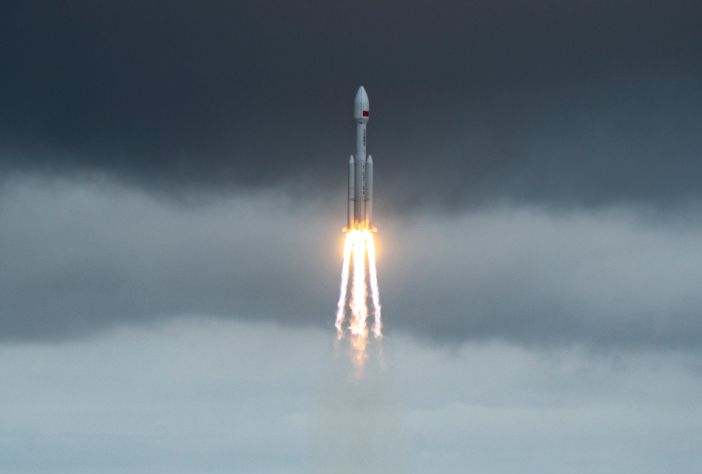
    A carrier rocket launched from waters off east China’s Shandong Province Wednesday has sent two hyperspectral satellites into orbit, which are expected to support high-precision observation in China and large-scale monitoring of land and sea worldwide.

    The Smart Dragon-3 (SD-3) carrier rocket blasted off at 10:38 a.m. (Beijing Time) near the city of Haiyang, delivering the Oriental Smart Eye (OSE) hyperspectral satellites 01 and 02 into planned orbit. The offshore mission was conducted by the Taiyuan Satellite Launch Center.

    Weighing around 300 kg each, the satellites each carry a hyperspectral imager featuring 22 calibrated spectral bands, a spatial resolution of 5 meters and an imaging swath of 300 km. Together, the pair is designed to provide global revisit coverage every five days, according to the developer.

    The two OSE satellites can not only capture images but also interpret what they observe.

    Unlike conventional optical imaging, hyperspectral observation records a detailed spectrum for each image pixel. These “spectral fingerprints” can help distinguish materials and measure properties, including vegetation chlorophyll and moisture, water quality, soil organic matter and mineral composition.

    The satellites also carry onboard artificial intelligence computing modules with computing capacity of up to 400 trillion operations per second.

    Such computing power effectively moves part of the AI inference normally performed on the ground into orbit. The satellites can therefore process what they observe in space, shifting from merely transmitting images to delivering usable results. According to the developer, each satellite has computing power roughly equivalent to that of 20 high-performance laptops.

    The modules are designed to perform in-orbit processing, including anomaly detection, surface-feature identification, intelligent compression and feature extraction, instead of transmitting all raw imagery to the ground for processing. This could reduce the amount of data to be downlinked and shorten the time for delivering usable information from days to minutes.

    Satellite 01, part of a space cooperation project between China and Indonesia, is expected to help safeguard agricultural production in Indonesia by precisely tracking crop growth and assessing disaster risks, according to the developer.

    Satellite 02, part of a space cooperation project between China and Uzbekistan, is designed to support the landlocked country’s full-cycle monitoring of cotton cultivation from sowing to harvesting.

    Once in operation, the pair will work with a separate high-resolution satellite already in orbit to form a system combining broad-area surveys with detailed observations.

    https://english.news.cn/20260805/b1fd1c556eba45dea998dc14d2629ba6/c.html

    Previous ArticleChina targets 50-pct non-fossil power generation by 2030
    Next Article China’s service trade grows 8.3 percent in first half of 2026

    Related Posts

    Robotics industry thriving in China’s Tianjin

    8 August 2026 News

    Date palms enter fruiting stage in China’s Hainan

    8 August 2026 News

    Middle route of China’s mega water diversion project hits new service milestone

    8 August 2026 News

    Kuşak ve Yol İnisiyatifi Ekonomi ve Kültür Derneği
    Belt and Road Initiative Association for Economy and Culture
    一带一路经济与文化协会

    Contact Us

    Abide-i Hürriyet Caddesi A Blok No: 211 K: 1 D: 64 34381 Şişli/İstanbul-TÜRKİYE

    Tel: +90 (212) 982 49 32

    E-mail: info@kusakveyol.org

    Facebook X (Twitter) Instagram YouTube LinkedIn
    © 2026 Belt and Road Initiative Association for Economy and Culture. All Rights Reserved.
    • Corporate
    • Belt and Road Initiative
    • News
    • Analysis
    • Infographic
    • Interview
    • Report

    Type above and press Enter to search. Press Esc to cancel.