Close Menu
    Facebook X (Twitter) Instagram
    Facebook X (Twitter) LinkedIn
    Kuşak ve Yol
    • Corporate
      • About Us
    • Belt and Road Initiative

      Brief History

      14 January 2024

      Belt and Road Initiative Investment Projects

      13 January 2024

      Financing

      13 January 2024
    • News

      China raises concerns over EU supplier rules, defends Japan export controls

      22 January 2026

      Xi signs order to promulgate regulations on military theory work

      21 January 2026

      Xi stresses securing good start for new five-year plan

      20 January 2026

      Xinhua Headlines: Xi calls for advancing building of China-Canada new strategic partnership

      19 January 2026

      China’s Shenzhou-20 return capsule touches down on Earth

      19 January 2026
    • Publications
      1. Analysis
      2. Infographic
      3. Interview
      4. Report
      5. View All

      China’s Economic Rise in Central Asia and the Pluripolar Future

      22 January 2026

      Canada-China Rapprochement: Hegemonic Transformation After the Venezuela Crisis

      20 January 2026

      China’s 2027 Artificial Intelligence Supply Chain Goal and Strategic Autonomy

      19 January 2026

      China’s Collective Memory of the Global South: Building a “Comunity of Shared Destiny” Narrative with Africa in the 70th Year

      15 January 2026

      Infographic The Key to Global Prosperity: Belt and Road

      20 December 2025

      Infographic Contributions of the Belt and Road Initiative to the Caucasus 

      18 December 2025

      Projects Conducted in the Context of Belt and Road Inıtiative

      3 October 2025

      BRI Investments in ASEAN Region

      2 June 2025

      Astana Information Technologies University, Asst. Prof. Ainur Slamgazhy: “Through CSR, China’s Role on the Global Stage Significantly Affects the Project’s International Image and Perception.”

      12 October 2024

      University of Punjab, Prof. Dr. Rehana Saeed Hashmi: “China Has Portrayed a Strategic Vision with Its BRI.”

      20 September 2024

      Khalid Taimur Akram, The Executive Director of PRCCSF: “While it is still too early to assess the full impact of the BRI, it is clear that there have been some reported successes.”

      8 March 2024

      Director of the China-Eurasia Council Dr. Mher Sahakyan; “China Agrees to Align Its Mega Initiative with the Turkic Central Corridor and Kazakhstan’s ‘Bright Road Development Strategy.”

      21 February 2024

      CAICT, Research Fellow Bingyi Yang: “China Places Great Emphasis on the Development of Artificial Intelligence (AI)”

      25 March 2025

      Belt and Road Initiative 2024 1st Term Report Now Available!

      4 November 2024

      Türkiye-China Relations: On the Basis of Belt and Road Cooperation Common Vision and Strategic Cooperation for Humanity Report is Now Available on Our Website!

      4 November 2024

      China’s Relationship with The south Caucasus Countries within The Framework of the Belt and Road Initiative

      14 June 2024

      China’s Economic Rise in Central Asia and the Pluripolar Future

      22 January 2026

      Canada-China Rapprochement: Hegemonic Transformation After the Venezuela Crisis

      20 January 2026

      China’s 2027 Artificial Intelligence Supply Chain Goal and Strategic Autonomy

      19 January 2026

      China’s Collective Memory of the Global South: Building a “Comunity of Shared Destiny” Narrative with Africa in the 70th Year

      15 January 2026
    • Contact Us
    • English
      • Türkçe
      • English
      • 中文 (中国)
    Kuşak ve Yol
    Anasayfa » From strategic pivot to global engine: China’s decade of supply-side reform and industrial revolution
    News

    From strategic pivot to global engine: China’s decade of supply-side reform and industrial revolution

    Kusak ve YolBy Kusak ve Yol19 January 2026
    Share
    Facebook Twitter LinkedIn Pinterest Email Telegram

    Editor’s note: Zhang Jianping, a special commentator on current affairs for CGTN, is deputy director of the academic committee of the Chinese Academy of International Trade and Economic Cooperation of the Ministry of Commerce. Dong Jianye is Zhang’s research assistant from the Institute of Economic Research at Xiamen University. The article reflects the authors’ opinions and not necessarily the views of CGTN.

    Ten years have passed since January 18, 2016, when Chinese President Xi Jinping delivered a seminal address at a study session, systematically expounding on the “new normal” of China’s economic development and the strategic necessity of supply-side structural reform. That moment marked a decisive inflection point in China’s modern economic history – a deliberate pivot away from the debt-fueled, demand-side stimulus of the past toward a model predicated on quality, efficiency and structural optimization.

    Standing in 2026, the trajectory of the past decade reveals that this philosophy was not merely a domestic adjustment but a roadmap for profound industrial metamorphosis. Guided by its new development philosophy featuring innovation, coordination, greenness, openness and shared development, China has successfully cultivated dynamic new growth drivers – specifically in semiconductors, shipbuilding, lithium batteries, solar panels and new energy vehicles (NEVs) – that are now powering not just China’s high-quality development, but the global economy as well.

    The success of this reform is most visible in the meteoric rise of industries such as electric vehicles (EVs), lithium batteries and solar products, which have replaced traditional low-value manufactures as the pillars of Chinese foreign trade. This shift is the direct result of the supply-side strategy to improve weak links and invest in high-tech capacity.

    In the automotive sector, the results are remarkable. In 2025, China’s annual production and sales of NEVs both exceeded 16 million units, ranking first globally for 11 consecutive years. This industrial upgrade has spilled over into global markets, where Chinese EVs are accelerating the green transition by offering advanced technology at accessible price points.

    Similarly, in the lithium battery sector, China has secured a dominant position, with exports reaching $61.1 billion in 2024, ensuring the stability of global supply chains for everything from consumer electronics to grid energy storage.

    Furthermore, the supply-side reforms have revitalized heavy industry through technological innovation, most notably in shipbuilding. By pivoting toward high-value vessels like liquefied natural gas carriers and green-fuel ships, China has cemented its status as the world’s shipbuilder. Data from 2025 reveals that China captured approximately 70 percent of all new global shipbuilding orders, a testament to its manufacturing resilience and efficiency.
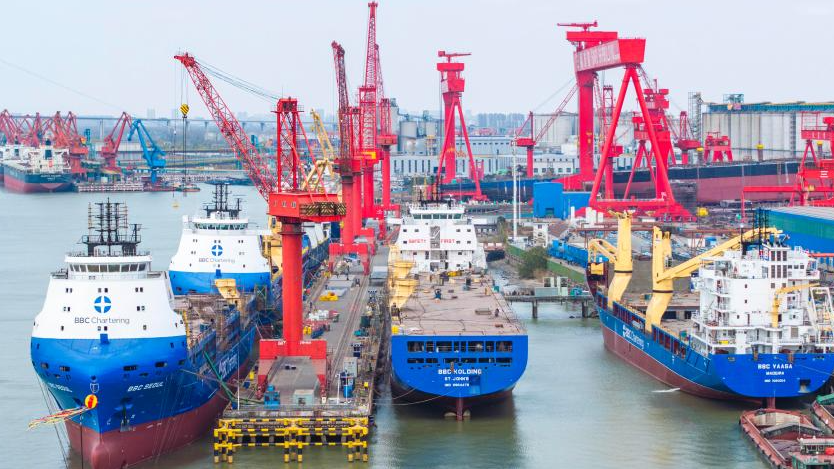
    Large vessels under construction at a shipbuilding company in Taizhou, eastern Jiangsu Province, China, December 27, 2025. /Xinhua

    Large vessels under construction at a shipbuilding company in Taizhou, eastern Jiangsu Province, China, December 27, 2025. /Xinhua

    In the critical domain of semiconductors, China has turned external pressure into internal momentum. Despite strict export controls imposed by some Western nations, China’s integrated circuit industry has expanded its capacity in “legacy” or foundational chips, which are the workhorses of the global industrial economy. In late 2025, exports of integrated circuits continued to show robust double-digit growth, satisfying the voracious hunger of the digital economy in Southeast Asia and beyond.

    Crucially, this industrial capacity is not, as some critics allege, a source of “overcapacity” that threatens the world, but rather a vital contribution to global stability and development. China’s vast production capabilities have significantly lowered the cost of clean energy technology, making the climate goals of the Paris Agreement attainable for developing nations.

    For instance, in the 12 months leading up to mid-2025, imports of Chinese solar panels to Africa surged by 60 percent, providing gigawatts of clean, affordable power to a continent historically plagued by energy deficits. This aligns perfectly with the “shared development” aspect of the new development philosophy, proving that Chinese modernization offers tangible dividends to the Global South.

    By supplying the “hardware” for the global green transition – efficient solar panels, affordable EVs and reliable ships – China is providing a “China solution” to the dual challenge of economic stagnation and climate change.

    As China moves towards its 15th Five-Year Plan (2026–2030) period, the foundation laid by the 2016 reforms appears more robust than ever. The economy has transitioned from being driven by factor inputs to being driven by innovation, with research and development expenditure reaching nearly 2.7 percent of GDP in 2024.

    This decade of structural reform has proven that a government can effectively guide the market to resolve structural imbalances, fostering industries that are both globally competitive and socially beneficial. In a fractured world economy, China’s adherence to these principles serves as a stabilizing anchor, demonstrating that high-quality development is not a zero-sum game, but a pathway to shared global prosperity.

    https://news.cgtn.com/news/2026-01-18/China-s-decade-of-supply-side-reform-and-industrial-revolution-1K1TBagiQ12/p.html

    Previous ArticleGraphics: China’s GDP exceeds 140 trillion yuan in 2025
    Next Article China’s Shenzhou-20 return capsule touches down on Earth

    Related Posts

    China raises concerns over EU supplier rules, defends Japan export controls

    22 January 2026 News

    Xi signs order to promulgate regulations on military theory work

    21 January 2026 News

    Xi stresses securing good start for new five-year plan

    20 January 2026 News

    Kuşak ve Yol İnisiyatifi Ekonomi ve Kültür Derneği
    Belt and Road Initiative Association for Economy and Culture
    一带一路经济与文化协会

    Contact Us

    Abide-i Hürriyet Caddesi A Blok No: 211 K: 1 D: 64 34381 Şişli/İstanbul-TÜRKİYE

    Tel: +90 (212) 982 49 32

    E-mail: info@kusakveyol.org

    Facebook X (Twitter) Instagram YouTube LinkedIn
    © 2026 Belt and Road Initiative Association for Economy and Culture. All Rights Reserved.
    • Corporate
    • Belt and Road Initiative
    • News
    • Analysis
    • Infographic
    • Interview
    • Report

    Type above and press Enter to search. Press Esc to cancel.