
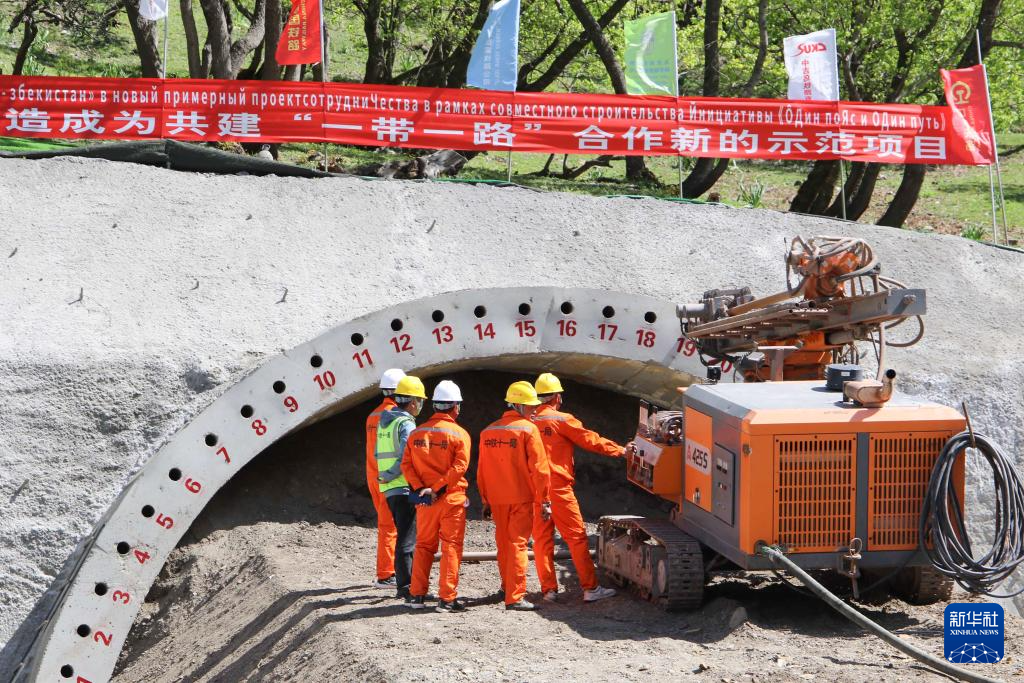

According to the China State Railway Group, construction has officially begun on April 29 at 10:00 a.m. local time in Kyrgyzstan (12:00 p.m. Beijing time) on three major tunnels—Fergana Mountains, Naryn-1, and Koshtetube—located within the Kyrgyz segment of the China-Kyrgyzstan-Uzbekistan (CKU) Railway. This marks the start of substantial construction work on the railway’s main line.
The CKU Railway is a flagship Belt and Road Initiative project, personally supported by the heads of state of China, Kyrgyzstan, and Uzbekistan. The railway starts in Kashgar, Xinjiang, China, passes through the Torugart Pass into Kyrgyzstan, continues through Jalal-Abad, and ends in Andijan in eastern Uzbekistan.
Under the project’s framework, China is responsible for construction within its own borders, Uzbekistan is upgrading its domestic section, and the Kyrgyz segment is being financed, built, and operated by the China-Kyrgyzstan-Uzbekistan Railway Co., jointly established by authorized enterprises from the three countries. The Chinese side is represented by China Railway International Co., under the China State Railway Group.
The three tunnels under construction are each over 10 kilometers long, single-track, single-bore tunnels. They are considered the most technically challenging parts of the project due to their “four highs”: high altitude, cold climate, strong seismic activity, and high geostress. The complex geological conditions and difficult access make construction particularly demanding.
Officials stated that the China State Railway Group will closely cooperate with Kyrgyz and Uzbek railway enterprises to ensure efficient, high-quality progress. The goal is to make the CKU Railway a model Belt and Road Initiative project that strengthens regional connectivity and benefits the people of all three countries.
A trilateral intergovernmental agreement was signed on June 6, 2024, followed by the project’s launch ceremony on December 27, 2024. Since then, efforts have been underway in line with local laws and regulations to advance feasibility studies, environmental assessments, land acquisition, and bidding processes.
The project is expected to significantly boost regional socio-economic development and infrastructure connectivity, while deepening trade cooperation among Belt and Road partner countries.