
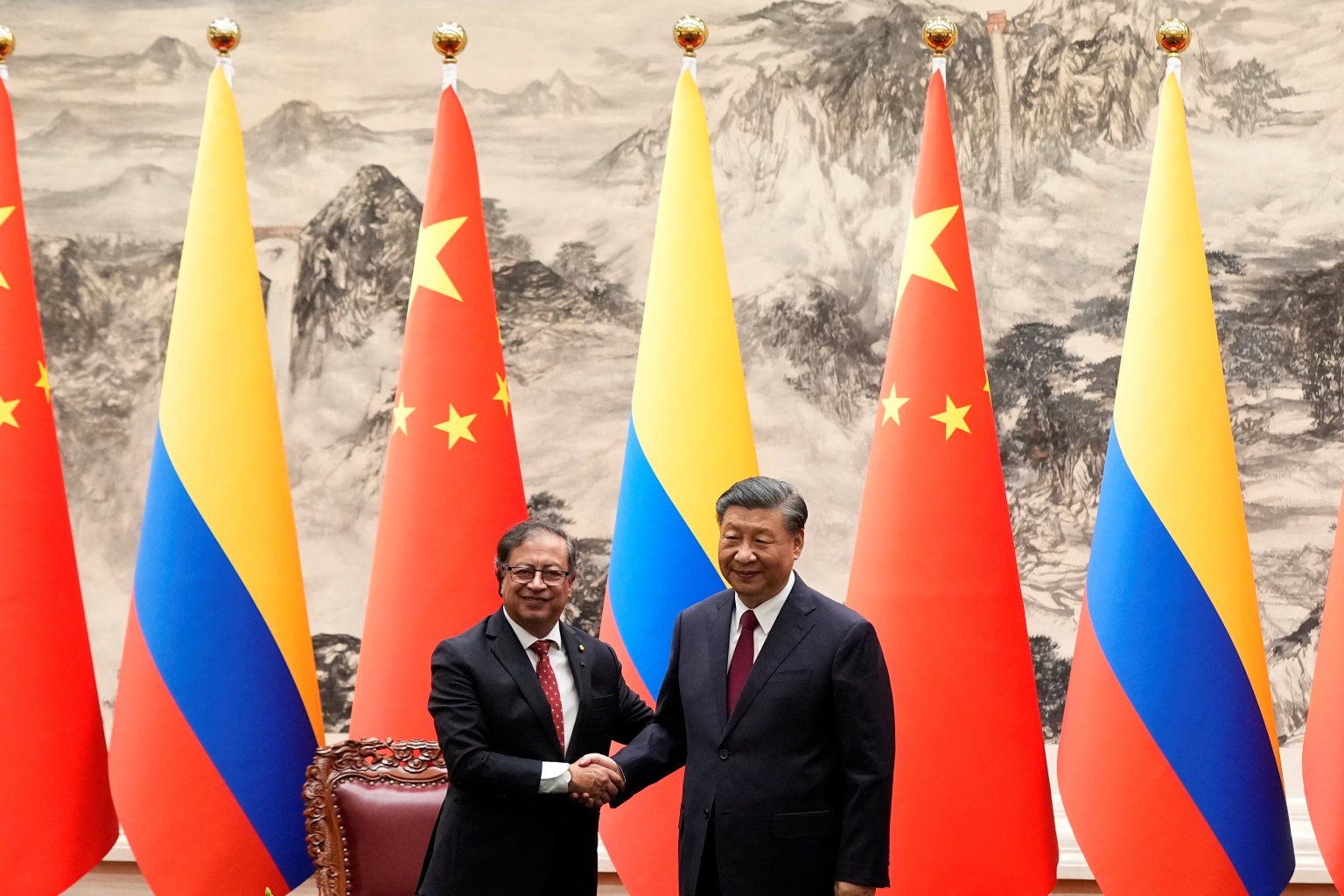

The announcement on May 14, 2025, that China and Colombia signed a cooperation plan within the Belt and Road Initiative (BRI) framework reflects not only the deepening of economic relations between the two countries but also the shifting geopolitical balances in Latin America.[i] This step demonstrates the institutionalization of China’s influence on the continent and the shift of traditionally United States-aligned countries like Colombia toward a multi-dimensional foreign policy.
The statements of Colombia’s Foreign Minister Laura Sarabia emphasise the significance of this agreement: “The boldest step taken in decades.”[ii] The document signed with China opens up a wide range of opportunities for Colombia, both economically and strategically. First and foremost, projects under the BRI may bring substantial resources in tangible areas of physical development such as infrastructure investments, transportation links, port construction, and railway projects.
Compared to countries like Brazil, Argentina, and Chile, where China has established a strong presence through significant projects, it can be said that Colombia joined the BRI relatively late. However, this late participation may not indicate a delayed response to China’s strategic expansion in the region, but rather a carefully considered entry. Foreign direct investment from China could inject dynamism into the Colombian economy in agriculture, mining, energy, and digital infrastructure. In particular, China’s interest in importing high-quality agricultural products could open new markets for Colombian producers.
From China’s perspective, Colombia’s participation in the BRI is part of its broader strategic expansion in Latin America. China’s growing economic integration with the region signifies increased trade and an enhanced capacity to shape norms, export technology, and expand its geopolitical sphere of influence. Colombia is China’s second-largest trading partner in the region, and in recent years, China has surpassed the United States as Colombia’s top source of imports.[iii] This can be interpreted as a successful example of Beijing’s “influence through trade” strategy.
China’s relations with Colombia are not limited to infrastructure projects and trade; cultural exchanges, scholarship programs, and media collaborations also shape them. Confucius Institutes appeal to the younger generation in Colombia by promoting Chinese language education and introducing Chinese culture. Such elements of soft power enhance China’s ability to influence regional public opinion as part of its long-term strategy. Colombia’s openness to cooperation with China in higher education and technology could accelerate this transformation.
Colombia’s move may be particularly concerning from Washington’s perspective. For many years, Colombia has been one of the United States’ closest allies in Latin America; under “Plan Colombia,” it received substantial aid from Washington through military cooperation and anti-narcotics programs.[iv] However, President Gustavo Petro’s multilateral foreign policy approach has deviated from a traditionally U.S.-centered foreign policy orientation in recent years.
Considering the claims that U.S. pressure was behind Panama’s decision to withdraw from the BRI in February 2025, it is likely that Washington will also exert diplomatic pressure on Colombia. However, rather than direct sanctions, it seems more probable that the U.S. will resort to more indirect means, such as suspending investment projects, reassessing trade priorities, or sending warnings through financial institutions.
Particularly within the U.S. Congress, segments that view China’s influence in Latin America as a “threat” may interpret Colombia’s decision as a “national security issue.” However, since Colombia has framed this move as economically driven and not as a shift in alliances but as a pursuit of multilateral opportunities, the intensity of the U.S. response may remain relatively limited.
The Petro administration’s participation in the BRI is not simply a turn toward China but an extension of a broader diversification strategy in Colombia’s foreign policy. While maintaining its security and defense cooperation with the United States, Colombia strives to deepen its relations with the European Union (EU), particularly in environmental transformation and human rights areas. Within this framework, economic cooperation with China reflects Colombia’s effort to strike a balance among global powers. However, the sustainability of this balancing policy is believed to be directly linked to external pressures and domestic political stability.
Diplomatic relations between Colombia and China were established in 1980, but real momentum has only been gained in recent years.[v] President Petro’s official visit to Beijing in October 2023 elevated the relationship to the level of a “strategic partnership.” This development signifies a strengthening of commercial ties and an intensification of political and cultural exchanges.
More than 20 countries in Latin America have joined the BRI.[vi] In this context, although somewhat late, Colombia’s participation is consistent with the broader regional trend. However, the Petro administration’s characterization of this step as an “irreversible opening” suggests that it is not merely a temporary economic partnership but a longer-term strategic orientation.[vii]
Colombia’s official accession to the BRI signifies the strengthening of bilateral relations between the two countries and clearly reflects Latin America’s increasingly central role in the global balance of power. The fact that a country like Colombia, historically known for its close ties to the United States, is now moving toward strategic cooperation with an emerging power like China stands out as both a symbolic and practical example of the transformation underway in regional foreign policy dynamics.
This step also highlights the Petro administration’s foreign policy approach based on diversification. While maintaining cooperation with the United States in security and with the European Union on environmental and human rights issues, Colombia is building economic and infrastructure-based partnerships with China. These moves indicate that Colombia is steering toward a multipolar foreign policy vision within the global system. Rather than signaling an alliance shift, this vision points to a developmental and opportunity-driven orientation to strengthen the country’s capacity for independent decision-making.
This development will inevitably cause discomfort for the United States, as Washington views Beijing’s rise in Latin America as an economic and strategic challenge. However, how Colombia manages the balance between its pursuit of economic development and mounting geopolitical pressure will determine the Petro administration’s foreign policy capacity and flexibility in the coming period. While direct sanctions from the U.S. appear unlikely, diplomatic pressure, indirect warnings through credit mechanisms, and delaying moves in regional cooperation frameworks are all within the realm of possibility.
In conclusion, Colombia’s accession to the BRI represents bilateral cooperation between the two countries and offers insights into how Latin America’s future foreign policy landscape may take shape. In a world where traditional alliances alone are no longer sufficient, it has become inevitable for medium-sized countries to seek alternative development paths. Colombia’s bold decision signals the beginning of a new era in Latin America’s relations with China, while also revealing how global polarization is being reflected in new ways across the region.
Ali Caner İNCESU
[i] “China, Colombia Sign Belt and Road Cooperation Pact”, Reuters, www.reuters.com/world/china-colombia-sign-belt-road-cooperation-pact-2025-05-14/, (Date Accession: 18.05.2025)
[ii] Ibid.
[iii] Li, Hang. “China-Colombia Trade Hits Record of 48 Billion Yuan in First Four Months: Official Data”, Global Times, https://www.globaltimes.cn/page/202505/1334024.shtml, (Date Accession:18.05.2025).
[iv] “U.S. Global Leadership Coalition”, Plan Colombia. U.S. Global Leadership Coalition, 2017, https://www.usglc.org/media/2017/04/USGLC-Plan-Columbia.pdf, (Erişim Tarihi: 18.05.2025).
[v] “China-Colombia Economic Ties: A Growing Partnership in Latin America”, China Briefing, 2025, https://www.china-briefing.com/news/china-colombia-economic-ties-trade-investment, (Date Accession: 18.05.2025).
[vi] Nedopil, Christoph. “Countries of the Belt and Road Initiative (BRI)”, Green Finance & Development Center, https://greenfdc.org/countries-of-the-belt-and-road-initiative-bri, (Date Accession: 18.05.2025).
[vii] Sarabia, Laura. “Colombia’s Foreign Minister Laura Sarabia said on Wednesday that the decision to join China’s flagship overseas development project was the South American country’s ‘boldest step in decades”, Reuters, https://www.reuters.com/world/china-colombia-sign-belt-road-cooperation-pact-2025-05-14, (Date Accession: 18.05.2025).