
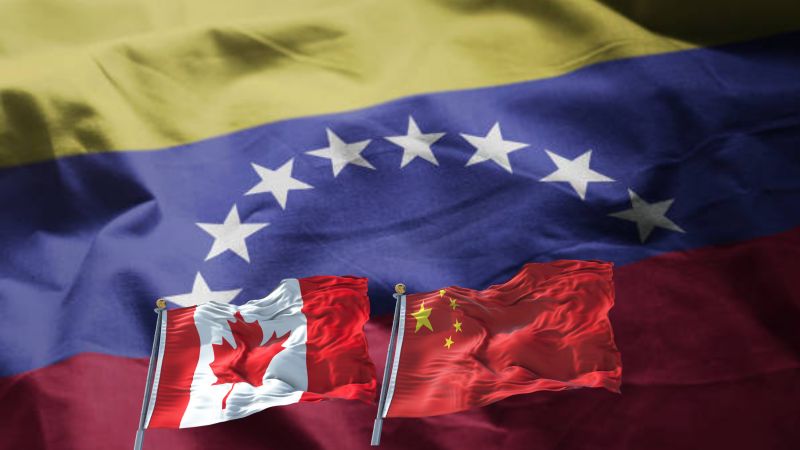

The United States’ (US) military intervention in Venezuela on January 3, 2026, resulting in the capture of Nicolás Maduro, known as Operation Absolute Resolve, marks a significant turning point in international relations. This move, aimed at consolidating the US’s hegemonic position in the Western Hemisphere as part of a reinterpretation of the Monroe Doctrine known as the “Trump Corollary,” has increased global instability.[i] Although the operation was justified on the grounds of narcotics-related terrorism charges, it has drawn widespread criticism for violating international legal norms. In this context, Canada’s rapprochement with China can be seen as a strategic initiative against the United States’ unilateral policies. Canadian Prime Minister Mark Carney’s visit to Beijing in January 2026 was the first high-level contact in eight years. These contacts emphasize trade diversification and multilateral cooperation.[ii]
The intervention in Venezuela reflects the US’s efforts to reestablish its influence in Latin America. The operation was supported by large-scale air strikes in Caracas and resulted in Maduro being tried in New York on charges of narco-terrorism. This action was deemed a violation of international law by UN experts and was criticized, particularly for civilian casualties and the violation of sovereignty. Following the intervention, instability increased in Venezuela under the interim presidency of Delcy Rodríguez, and economic sanctions and an oil embargo further exacerbated the country’s situation. In the Global South, this event created a wave of reaction against the US’s coercive diplomacy, known as “gunboat diplomacy.” The intervention reinforced the Global South countries’ distrust of the US and accelerated their search for alternative powers.[iii]
The US intervention in Venezuela demonstrates how unilateral actions by hegemonic powers contribute to global instability. The operation disregarded international law by using military force under the pretext of US allegations of narco-terrorism. United Nations (UN) experts emphasized that this action violated Article 2(4) of the UN Charter and criticized it for its consequences, including civilian deaths and the destruction of oil facilities. The intervention deepened Venezuela’s internal instability; after Maduro’s capture, the Rodríguez government faced economic collapse and social protests. This situation disrupted regional balances in Latin America, directly affecting countries such as Cuba and Colombia.[iv]
The global repercussions of instability are particularly evident in the Global South. The intervention has revived the US’s backyard approach in Latin America, increasing anti-US sentiment in countries such as Brazil and Mexico. It is thought that this action could embolden Russia in Europe and affect the Ukraine Crisis. Furthermore, the operation’s disruption of oil markets threatens global energy security and has put China’s oil investments in Venezuela at risk. In this context, instability is accelerating the transition to a multipolar world order as a result of hegemonic competition.[v]
Canada has turned to China in order to reduce its dependence on the US amid this unstable environment. Carney’s visit reflects the uncertainty created by the US move on Venezuela. The intervention has called into question Canada’s economic integration with the US and cast doubt on the future of the United States-Mexico-Canada Agreement (USMCA). In this context, the Canada-China rapprochement can be seen as a strategy to capitalize on the opportunities created by instability. The warming of Canada-China relations can be examined in economic, political, and geopolitical dimensions. Economically, Canada’s dependence on the US (75% of exports) has been threatened by Trump’s 25% tariffs. Carney’s visit aims to diversify trade by utilizing China’s massive market, targeting the resolution of electric vehicle tariffs and canola seed disputes.[vi]
On the political front, relations, which had soured following the 2019 arrest of Huawei executive Meng Wanzhou at a Canadian airport at the request of the US, are being softened by Carney’s emphasis on a new type of strategic partnership.[vii] Chinese Foreign Minister Wang Yi proposes confidence-building communication and elimination of interference, while Canada emphasizes multilateral cooperation (climate change, energy). This rapprochement is part of Canada’s efforts to increase its strategic autonomy.[viii]
Geopolitically, following the intervention in Venezuela, the US Donroe Doctrine has brought Canada closer to China. This rapprochement serves as a counterbalance to US hegemony.[ix] These dimensions reflect Canada’s realistic approach to restructuring the balance of power. However, there are limitations in areas such as national security and human rights.
The Global South is experiencing growing unease about US hegemonic actions following the intervention in Venezuela. The intervention has deepened organized crime and migration problems in Latin America, triggering the spread of criminal organizations (ELN, Tren de Aragua) in countries such as Brazil and Colombia. Instability attracts foreign criminal groups. The intervention has revived the US’s “gunboat” diplomacy in the Global South, increasing anti-US sentiment in African and Asian countries. Countries such as South Africa and Ghana have demanded Maduro’s release, reinforcing the Global South’s defense of sovereignty. This event strengthens China’s image of defending the UN Charter. The Canada-China rapprochement sets an example for the Global South and supports the search for a multipolar order. The humanitarian crises in Venezuela continue, with aid organizations drawing attention to the uncertainty. [x]
As a result, China is challenging US hegemony, but it is not pursuing global dominance to replace it. Instead, it emphasizes that it wants a multipolar order. China’s soft power (investments, trade) is effective in the Global South, and it criticizes US hypocrisy. The increased instability following the US intervention in Venezuela has brought hegemonic transition theories (e.g., Organski’s power transition model) back to the forefront in the discipline of international relations, positioning the Canada-China rapprochement as a structural response, a process that is accelerating the formation of a multipolar world order. Indeed, while the US’s unilateral actions lead to the erosion of sovereignty norms in the Global South, China’s “win-win” diplomacy is emerging as a new balancing factor in the world. In future scenarios, from a realist perspective, Canada’s strategic move may become permanent under US pressure, and as predicted, the fragmentation of global trade may deepen Canada-China economic integration. In contrast, structuralist approaches emphasize that Western countries’ ideological reactions (e.g., human rights rhetoric) will limit this rapprochement, while the Global South will continue to seek autonomy by leveraging China’s soft power. As hegemonic competition is likely to evolve into hybrid warfare in the period extending to the 2030s, Canada-China relations will constitute a critical testing ground for managing global instability in this context.
[i] “Trump’ın Venezuela baskınını gerekçelendirdiği ‘Monroe Doktrini’ nedir?”, Euro News, https://tr.euronews.com/2026/01/07/trumpin-venezuela-baskinini-gerekcelendirdigi-monroe-doktrini-nedir, (Date Accessed: 15.01.2026).
[ii] “The global implications of the US military operation in Venezuela”, Brookings, https://www.brookings.edu/articles/the-global-implications-of-the-us-military-operation-in-venezuela/, (Date Accessed:15.01.2026).
[iii] Ibid.
[iv] “UN experts condemn US aggression against Venezuela”, United Nations, https://www.ohchr.org/en/press-releases/2026/01/un-experts-condemn-us-aggression-against-venezuela, (Date Accessed:15.01.2026).
[v] “Venezuela: Navigating a New Era of Uncertainty”, Holland & Knight, https://www.hklaw.com/en/insights/publications/2026/01/venezuela-navigating-a-new-era-of-uncertainty, (Date Accessed: 15.01.2026).
[vi] “Canada’s strategic shift: Pragmatic cooperation with China amid US uncertainty”, CGTN, https://news.cgtn.com/news/2026-01-14/Canada-s-strategic-shift-Cooperation-with-China-amid-US-uncertainty-1JVrLpvvsfm/p.html, (Date Accessed:15.01.2026).
[vii] “Huawei’nin üst düzey yöneticisi Meng Wanzhou Kanada hükümetine dava açtı”, BBC News, https://www.bbc.com/turkce/haberler-dunya-47438281, (Date Accessed: 15.01.2026).
[viii] “Caught Between Superpowers, Canada Seeks a New Path in Beijing”, The New York Times, https://www.nytimes.com/2026/01/14/world/canada/carney-trip-china-relations-trump.html, (Date Accessed: 15.01.2026).
[ix] “As Carney visits China to diversify Canada’s trade, the ‘Donroe Doctrine’ further strains US relations”, Chatham House, https://www.chathamhouse.org/2026/01/carney-visits-china-diversify-canadas-trade-donroe-doctrine-further-strains-us-relations, (Date Accessed: 15.01.2026).
[x] “What are the implications of the US intervention in Venezuela for organized crime?”, Global Initiative, https://globalinitiative.net/analysis/what-are-the-implications-of-the-us-intervention-in-venezuela-for-organized-crime/, (Date Accessed: 15.01.2026).