
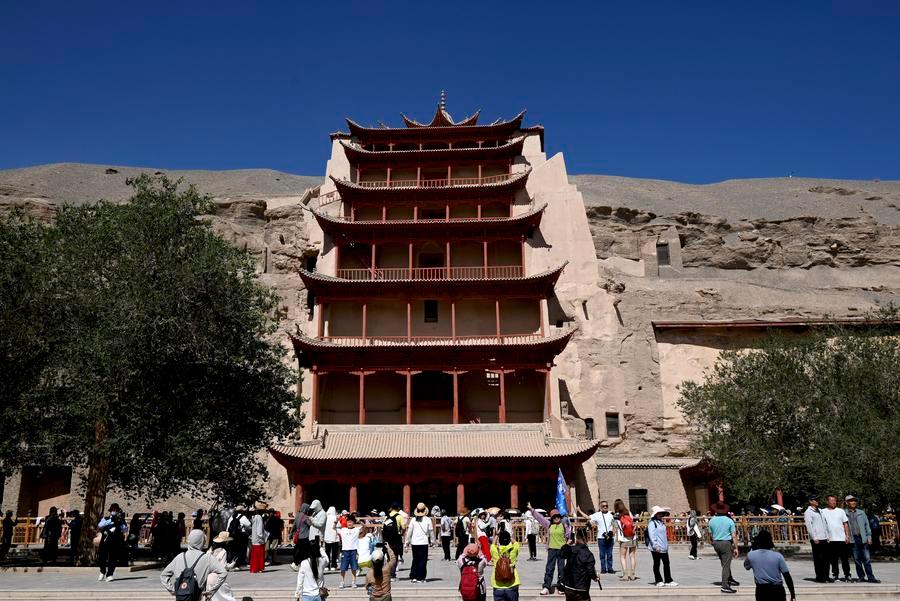

Visitors to the Mogao Grottoes often find themselves lost in reverie before the exquisite murals and delicate sculptures, swept away by centuries of Buddhist art and history.
Few ever glance back at the unassuming gray cave doors behind them. Yet those plain metal panels are anything but ordinary. They are the cave’s quiet sentinels, programmed to slide open automatically when carbon dioxide levels rise too high, letting in a cleansing breath of fresh air before the ancient pigments can be harmed.
These smart doors exemplify how the world-renowned Mogao Grottoes are harnessing technology to adapt to a changing climate.
Carved into cliffs deep in the Gobi Desert in Dunhuang, northwest China’s Gansu Province, the Mogao Grottoes date back to 366 A.D. Of the 735 surviving caves, 492 are decorated with murals and painted sculptures. UNESCO has recognized the site as the world’s largest, best-preserved and longest-serving treasure house of Buddhist art.
Arid conditions have been key to preserving the Mogao Grottoes for thousands of years. However, meteorological data show that the region is becoming both warmer and wetter.
Since 2000, the rate of precipitation increase in northwest China has been eight times that recorded between 1961 and 2000, according to meteorological data.
Guo Qinglin, director of the Dunhuang Academy, recalled how recent summer downpours flooded cave entrances and sent humidity levels soaring inside. “The threshold is 62 percent,” he said. “Above that, salts in the plaster layers deliquesce, and the relics begin to decay from within.”
Rain, sand, or shine — the doors respond, said Wang Xiaowei, director of the Dunhuang Academy’s cave monitoring center. “They seal out moisture during the rain, lock tight against blowing sand and open to ventilate on clear days, optimizing the internal environment with every shift in weather.”
These smart doors have been installed in select caves at Mogao and the Western Thousand-Buddha Caves.
The system runs on real-time data from over 600 sensors placed in and around the grottoes. The monitoring center’s big screens display everything in real time: cave temperature, humidity, carbon dioxide levels, visitor flow, and even rainfall and sandstorms across hundreds of kilometers around.
A red-yellow-green alert system flags danger. “When extreme weather hits, we stop ticket sales and seal the doors, cutting off moisture before it can reach the murals. Every closure buys the paintings more time,” Wang said.
To get ahead of potential risks, researchers at the Dunhuang Academy’s lab can simulate a range of weather conditions, from minus 30 degrees Celsius to 60 degrees Celsius, along with wind, rain, snow and sunlight.
“Time can be ‘accelerated’ in this facility,” Guo said, noting that a full annual cycle can be recreated in just 40 to 50 days in the lab. This allows the team to “preview” how relics will age in the wild and, with that foresight, craft preservation strategies before any real damage occurs.
Today, the Mogao Grottoes are shielded by a comprehensive protection system that tackles multiple challenges ranging from sandstorms, creeping regional warmth to a rise in sudden, heavy rainfall as seen this summer.
These hard-won approaches have crystallized into the “Dunhuang Solution” for grotto conservation, a framework now applied across the six grotto sites under the Dunhuang Academy’s purview, including the Mogao Grottoes and the Yulin Grottoes, also in Gansu.
Building on this success, Gansu Province, home to over 200 grottoes, plans to integrate its broader grotto resources into the monitoring platform, with customized risk-mitigation strategies tailored to the specific conditions of each site.
In 2014, “Silk Roads: the Routes Network of Chang’an-Tianshan Corridor,” jointly nominated by China, Kazakhstan and Kyrgyzstan, was added to UNESCO’s World Heritage List.
The insights gained from the “Dunhuang Solution” are now being shared with other historic sites along the ancient Silk Road.
Recently, the Silk Road heritage conservation technology advanced training program was launched in Dunhuang, bringing together trainees from Kyrgyzstan, Uzbekistan, Kazakhstan and Tajikistan to study alongside their Chinese counterparts.
Nazira Duishombekova, a trainee from Kyrgyzstan, said cultural heritage is facing a range of new challenges, including climate change, which calls for modern methods for research, conservation and restoration. “This training will help us work together to meet the common challenges.”
“Damage to caves is a dynamic, ongoing process. Preventing deterioration and ensuring the overall safety of murals remain our long-term mission,” said Shui Biwen, deputy director of the center for cultural heritage conservation technology services of the Dunhuang Academy.