
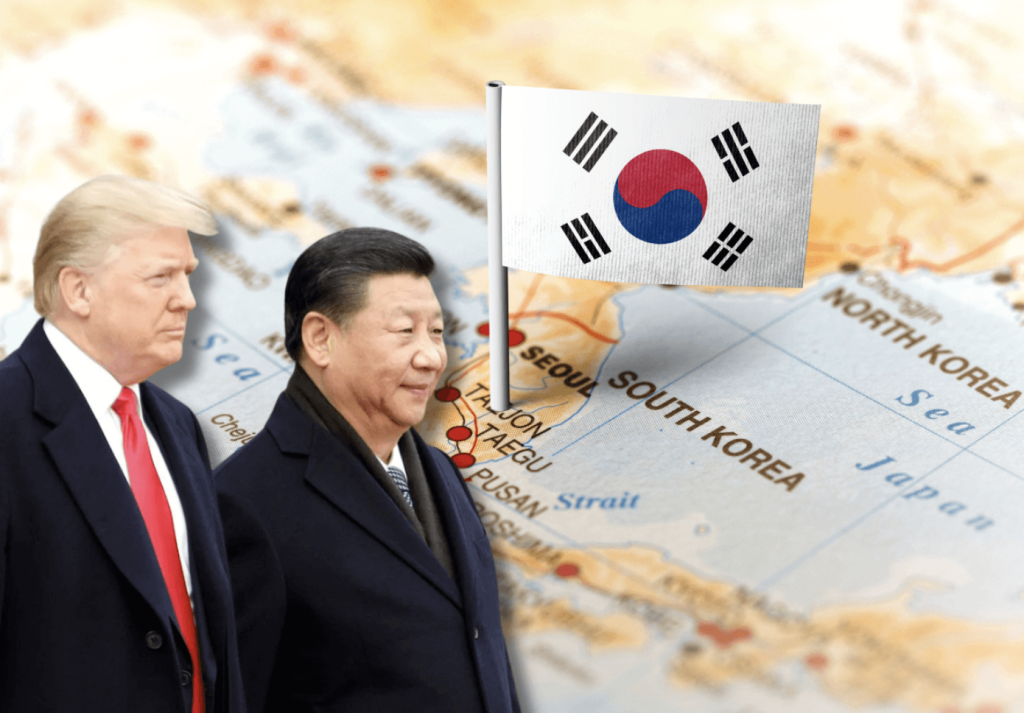

South Korea has been one of the most active diplomatic crossroads in Asia throughout history. Since the Cold War, the country has established strong military ties with the United States (U.S.) and strong economic ties with the People’s Republic of China. Today, it is making efforts to maintain a delicate balance in the area of competition between these two superpowers.
Since the Korean War, the United States has been South Korea’s most important security partner. The support provided by American soldiers between 1950 and 1953 is remembered as a “friendship forged in blood” between the two countries. However, China is South Korea’s largest trading partner. In other words, Seoul has inherited a structure in which it owes its security to Washington and its prosperity to Beijing. This situation has made things difficult for the Lee Jae-myung administration.
President Lee has portrayed himself as a leader who wants to maintain both economic growth and regional stability. His goal is to remove South Korea from being a side in the U.S.-China rivalry and to turn it into a “balancing actor” that can cooperate with both countries on the basis of mutual interests. This approach has been a modern reflection of the “balance policy” adopted by small and medium-sized states in the global competition environment.
The Lee administration has made this policy concrete by hosting both Trump and Chinese President Xi Jinping in Seoul. The meeting of the two leaders in the same city has placed South Korea in a unique diplomatic position. However, this situation also carries high risks, since the dissatisfaction of either side could cause economic or security problems in the long term.
Although the ties between the USA and South Korea have remained strong, some shadows have recently fallen on this relationship. The detention of hundreds of South Korean citizens at Hyundai facilities in the state of Georgia has damaged the sense of trust between the two countries. Nevertheless, most of the public still sees the USA as an “indispensable ally.” About 90% of South Koreans have described the USA as the country’s most important friend.[i]
The Trump administration’s demand for “more investment” from South Korea has created some doubts among the public. Especially the younger generations are worried that the USA sees the country only through an economic interest perspective. However, Washington’s role as the security guarantor on the Korean Peninsula has not changed. The presence of American troops continues to provide deterrence against the North Korean threat.
The USA has offered South Korea important opportunities in technology and defense cooperation. The strategic partnership between the two countries has deepened in areas such as semiconductor production, artificial intelligence, and space technologies. While the Lee government has strengthened these ties, it has also maintained its goal of increasing the country’s economic independence.
On the other hand, China is a market that makes up a large part of South Korea’s exports. Beijing’s stable growth has supported the lifeline of South Korea’s industry. Although relations were strained by the THAAD missile defense system crisis in 2016, the Lee administration has tried to rebuild trust between the two countries.
Xi Jinping’s visit to Seoul after 11 years has been an important sign of this process. His visit was seen not only as a diplomatic courtesy but also as a declaration of intent to deepen economic partnership. The Chinese side described South Korea as a “stable and reliable partner” in the Asia-Pacific region.[ii]
Lee Jae-myung has tried to reopen China’s investment and tourism channels. Granting visa facilitations to Chinese tourist groups aimed to bring vitality to the Korean economy. Although some circles found this policy “too soft,” it has produced positive results in the short term in terms of economic indicators.
In South Korean society, the concept of “freedom” holds a strong place. Protesters claimed that they were defending “freedom of expression.” However, the Lee government has also seen maintaining social peace and diplomatic courtesy as equally important. This attitude has reflected South Korea’s democratic maturity.
Xi Jinping’s longer stay in South Korea compared to Trump has shown the seriousness of China’s diplomatic move in the region. Xi also met with other leaders at the Asia-Pacific Economic Cooperation (APEC) summit in Gyeongju. This summit has offered South Korea new opportunities both economically and politically.
Lee Jae-myung also holds hope for re-establishing dialogue with North Korea. Xi’s support could play a key role in this matter. As in the period of Moon Jae-in, the Seoul administration aims to prepare the ground for peace talks with Pyongyang.
The USA has not shown a completely negative attitude on this matter either. Trump stated that he was “ready to meet.”[iii] For this reason, South Korea’s potential to become a “bridge state” that can bring the two superpowers to the same table, rather than being part of their rivalry, has increased.
Today, South Korea is not only a military or economic actor but also a center of “soft power.” It has created a wide area of cultural influence, ranging from K-pop to cinema, from technology to cosmetics. K-beauty stores on the streets of Seoul, television dramas, and traditional hanbok clothing have strengthened the country’s global brand value.
The Lee administration has known how to use this cultural capital as a diplomatic tool. Both the USA and China have been aware of the global influence of Korea’s cultural industry. Therefore, both sides have understood that winning Seoul is not only an economic issue but also a matter of cultural prestige.
As a result, South Korea is going through one of the most delicate diplomatic periods in its history. President Lee Jae-myung aims to maintain security ties with Washington while also improving economic relations with Beijing. During this process, he has followed a neutral, balanced, and national interest–based policy.
The USA has continued to be the backbone of Korea’s defense umbrella, while China has contributed to the dynamism of South Korea’s economy. Lee’s success lies in his ability to maintain balance between these two powers. Diplomacy is often the art of “pleasing everyone a little,” and the Lee administration has tried to practice this art skillfully.
In short, Seoul today is not only caught between two poles but has also become a “center of balance.” The future of South Korea will depend on how carefully it can maintain this balance. It seems that the Lee Jae-myung administration is carrying out this difficult task with great precision.
Ali Caner İncesu graduated from Anadolu University Faculty of Business Administration in 2012. He continued his education with Cappadocia University Tourist Guidance associate degree program and graduated in 2017. In 2022, he successfully completed his master’s degrees in International Relations at Hoca Ahmet Yesevi University and in Travel Management and Tourism Guidance at Ankara Hacı Bayram Veli University. In 2024, he graduated from the United States University of Maryland Global Campus (UMGC) Political Science undergraduate program. As of 2023, he continues his doctoral studies at Cappadocia University, Department of Political Science and International Relations. In 2022, Mr. İncesu worked as a special advisor at the Embassy of the Republic of Paraguay in Ankara. He is fluent in Spanish and English and is a sworn translator in English and Spanish. His research interests include Latin America, International Law and Tourism.
[i] Bicker, Laura. “‘No Trump! No China!’: Caught in the Middle, South Korea Hosts Rival Superpowers”, BBC News, https://www.bbc.com/news/articles/cy7eyg0808xo, (Access Date: 02.11.2025).
[ii] Ibid.
[iii] Ibid.