
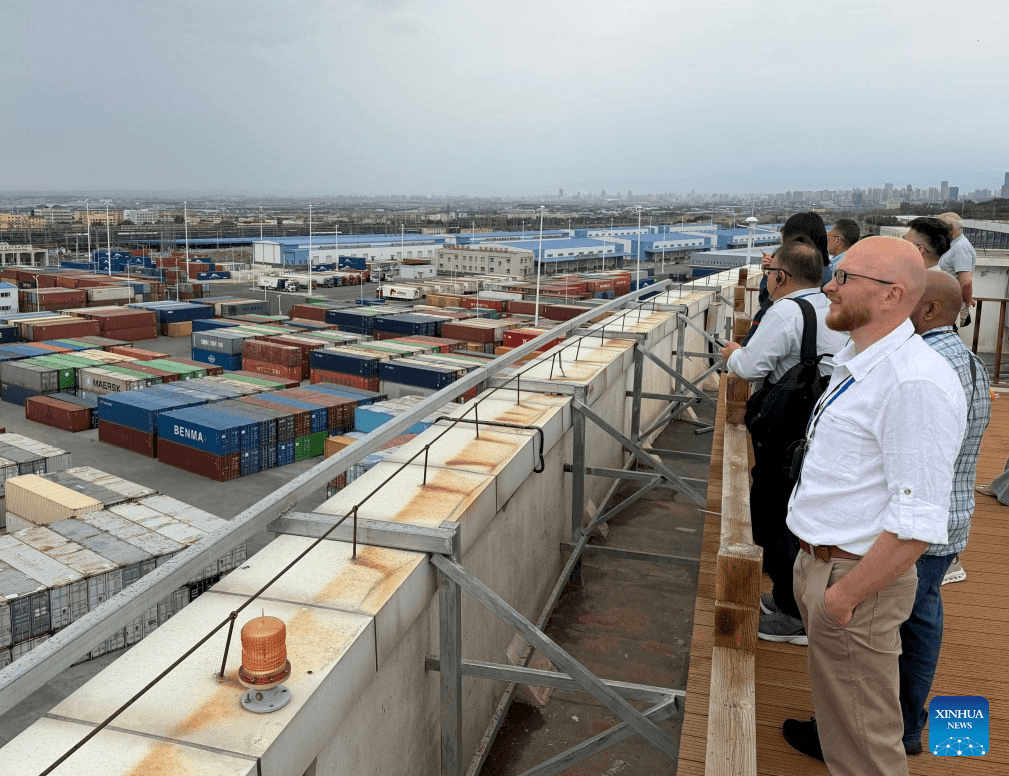

From the observation deck at the Urumqi International Land Port Area, Xinjiang looked less like a distant frontier than a region in motion.
Below, gantry cranes glided over stacks of containers as China-Europe freight trains stood ready for departure. It was a fitting introduction for a group of international media leaders, editors, and senior journalists on a nine-day tour across northwest China’s Xinjiang Uygur Autonomous Region.
From June 28 to July 6, a delegation of 17 media representatives from 14 countries, including Germany, Russia, Hungary, Spain and Kazakhstan, visited Urumqi, the Mongolian Autonomous Prefecture of Bayingolin and Turpan during the Silk Road Economic Belt Joint Construction Countries’ Media Head Seminar, hosted by China’s State Council Information Office. Through site visits, lectures and discussions, they gained a closer look at Xinjiang’s economic development, cultural heritage, ecological protection and public services.
For many of the visitors, what really stood out was the breadth of development they witnessed throughout the region.
At the Urumqi International Land Port Area, Syiagul Karaman, a columnist with Kyrgyzstan’s Koom Press News Agency, said she could already sense how quickly Xinjiang was changing. Ralida Mukanova, chief producer of Kazakhstan’s Almaty TV, who first visited Xinjiang in 2000, said the changes she had seen since then were astonishing.
The delegation also visited factories and agricultural bases, where they saw Xinjiang’s industrial upgrading up close. At CRCC Heavy Industry Xinjiang Co., Ltd., participants toured intelligent manufacturing workshops. Ercan Sarikaya, editorial director of Milliyet daily, a Turkish newspaper published in Istanbul, said Xinjiang’s industrial development and level of modernization were impressive, adding that its development experience offers valuable lessons worth learning from.
In Korla, the Yungengji Smart Farm Demonstration Base highlighted Xinjiang’s push in smart agriculture. Jesus Rodriguez Rojo, a columnist with Spain’s Mundo Obrero, said the region had developed a leading technical system in the field, with experience that could help Belt and Road partner countries upgrade local agriculture.
In Turpan, Ahmed Saail Ali, managing editor of the Maldives’ SunOnline, said he was struck by how local people were making use of the extreme heat. “Especially in Turpan, I saw it’s extremely hot, but they don’t take that as a disadvantage — they take advantage of it to make money,” he said, pointing to solar energy projects and vehicle testing he had seen there.
Before his visit, he explained, most of what he knew about Xinjiang came from online information — yet what he encountered on the ground stood in stark contrast: a profound sense of peacefulness.
The region’s infrastructure development also impressed members of the delegation. At the Geological Exhibition Hall of the Tianshan Shengli Tunnel, foreign journalists studied models of fault zones and learned more about the tunnel project. Thanks to the tunnel, a journey that once took hours along winding roads now takes just over 20 minutes.
For Anika Würz, a journalist with Germany’s Hamburger Abendblatt, the Tianshan Shengli Tunnel was one of the largest infrastructure projects she had seen in her life. “I think it really brings northern and southern Xinjiang closer together, so I guess the local farmers and also the economy will benefit from it,” she said.
Before the trip, Würz said, she knew little about Xinjiang, but now she has a much clearer understanding of its importance, both as a key region along the ancient Silk Road and in the context of today’s Belt and Road Initiative.
Not all the journey’s impressions came from steel and concrete. At Bosten Lake, reeds swayed in the wind and wild ducks burst from the water, while journalists raised their cameras to capture the tranquil scene.
Emin Gasimov, a scholar with the Azerbaijan-China Initiative Culture & Development Research Center, said that over the past decade or so, he had seen Xinjiang work to improve the environment, boost the economy and make life better for local people. “Xinjiang has done a fantastic job with environmental protection,” he said.
The seminar also included discussions about Xinjiang’s history, culture, economic development and people’s livelihoods. Geoffrey William Thompson, editor-in-chief of Luxembourg’s The Chronicle Online, said he was particularly interested in public services, especially healthcare, and noted that the local medical insurance system was affordable and widely used. He was also impressed by the variety of extracurricular activities local schools offer.
By the end of the trip, several media representatives observed that the visit had turned Xinjiang from a distant name into a place they now understood through vivid, firsthand encounters — at freight hubs and tunnel projects, on smart farms and lake shores, and in schools, hospitals and museums.