
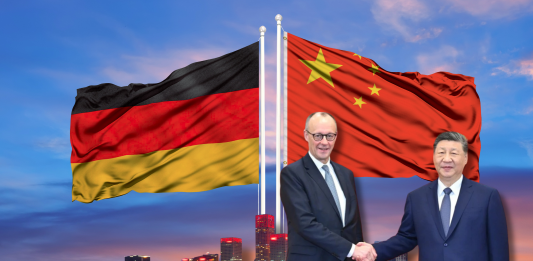

Friedrich Merz conducted his first official visit to China approximately ten months after taking office in May 2025. This visit signifies both the strengthening of bilateral economic relations and Europe’s pursuit of strategic autonomy in an era of rapidly shifting global power dynamics. According to Chinese sources, the visit is scheduled for February 25-26, 2026, with a primary focus on deepening economic cooperation.[i]
The Chinese side promotes a “win-win” partnership discourse, emphasizing that bilateral trade volume has exceeded $200 billion and mutual investments have surpassed $65 billion, accounting for approximately one-quarter of China-EU economic relations. However, this optimistic outlook contrasts with a structural imbalance referred to in Western sources as the “China shock”: In 2025, Germany’s trade deficit with China reached approximately €90 billion, with imports exceeding €170 billion while exports remained around €81 billion.[ii]
German-Chinese economic relations date back to the mid-19th century. This process initially began with trade agreements, evolved into military and technological cooperation during the first half of the 20th century, revitalized through post-World War II normalization, and gained significant momentum following the 1978 Chinese reforms. Early trade treaties between Prussia and China enabled initial investments by German firms such as Siemens and BASF. During the interwar period, the support provided by German military advisors to the Kuomintang Army clearly demonstrated the geopolitical importance of technology transfer. Following the establishment of diplomatic relations in 1972, German industry began systematically entering the Chinese market; notably, Volkswagen’s first joint venture in Shanghai during the 1980s ensured that German automotive technology played a key role in China’s industrialization process.[iii]
During this period, German machinery, chemicals, and engineering expertise played a significant role in China’s rise as the “world’s factory.” This mutual interdependence was further legitimized by the “Wandel durch Handel” (change through trade) doctrine. China’s accession to the World Trade Organization in the 2000s sparked a major surge in German exports, eventually leading to a point where sales through German subsidiaries within China surpassed direct exports. However, since the late 2010s, China’s rapid ascent in high-value-added sectors such as electric vehicles, renewable energy, and digital technologies has disrupted the previously symmetrical nature of this relationship.[iv]
By the mid-2020s, the profitability of German automotive giants in China declined rapidly while Chinese competitors began entering the European market with affordable electric vehicles. The fact that critical raw materials such as rare earth elements largely originate from China has rendered German industrial supply chains fragile. Beyond the decisions of politicians and corporate executives, this historical process demonstrates how material objects like machine tools, batteries, and rare elements form powerful networks that reshape international relations. Merz’s visit to China reflects a positioning caught between Germany’s pursuit of strategic autonomy and the uncertainty created by the Trump administration. Chinese sources frame the visit within the context of maintaining free trade and the multilateral system, presenting the arrival of Merz’s delegation, which includes 30 senior executives from the automotive, chemical, biopharmaceutical, machinery, and circular economy sectors, as a deepening of practical cooperation. However, Western sources paint a different picture. Germany’s trade deficit with China has reached record levels. An 8.5% decline in machinery exports contrasted with a 12.5% increase in imports suggests that German industry is struggling to compete against state subsidized “zombie companies.” [v]
At the Munich Security Conference, Merz emphasized that there should be no illusions regarding China’s ambition to establish a new multilateral order according to its own rules. He further stated that he would address China’s indirect support for Russia in the Ukraine Crisis during his visit. This contradiction clearly demonstrates how political decisions are constrained by non-human factors. For instance, Merz’s visit to the Mercedes-Benz facility stands out as an object that embodies the deep dependence of the German automotive sector on the Chinese market. On the other hand, his visits to Unitree Robotics and Alibaba in Hangzhou serve as a reminder that embodied AI and the platform economy have become powerful new actors surpassing German companies.[vi]
Chinese Foreign Ministry Spokesperson Mao Ning’s statement that the Ukraine Crisis should not be an issue between China and Europe demonstrates an attempt to mask geopolitical divergences with economic pragmatism. However, the fact that China’s restrictions on rare earth element exports can halt German factories clearly proves how material objects can override political will. From a critical perspective, the “win-win” discourse frequently emphasized by China conceals the asymmetric and unbalanced nature of the relationship. Germany continues to transfer technological knowledge and know-how to maintain access to the Chinese market, while China’s state-supported companies rapidly gain market share in Europe, leading to approximately 10,000 job losses per month in Germany.[vii]
When analyzed within the framework of New Materialism and Actor-Network Theory (ANT)[viii] the Merz visit ceases to be a purely diplomatic event and becomes a dynamic assemblage in which human and non-human actors shape one another within a heterogeneous network. According to Latour’s ANT, an “actor” is not limited to humans; an electric vehicle battery, a rare earth element, or an algorithmic trading platform is equally agentic. The fields of clean energy, embedded expertise, biotechnology, and industrial digitalization proposed by China during this visit are precisely the areas where these non-human actors come to the fore.[ix]
Embodied AI, such as the robots from Unitree Robotics, is not merely a technological product but an actor that disrupts the traditional labor-intensive model of German industry and imposes new supply chain configurations. Rare earth elements possess a “vibrant” materiality. Through the agency of these elements, China’s export restrictions can halt German electric vehicle production lines, thereby determining Merz’s position at the negotiating table. Supply chains operate as a network. The investments of German chemical giant BASF in China alongside Siemens Energy’s facilities have gained a momentum that transcends human decision-making.
Potential agreements during the visit, such as the China-Germany Economic Advisory Committee meeting, are not merely texts on paper; they are exchange processes involving logistical objects like aircraft and microphones in conference rooms, digital signatures, and data flows. While German firms leak technology during production in China, Chinese competitors export those same technologies back to Europe more cheaply and with state support. Thus, despite the “de-risking” discourse, the network makes German industry even more dependent. Actors within this network, such as Alibaba’s e-commerce algorithms and China’s 5G/6G infrastructure, impose their own “programs” independently of human will. In this context, the visit serves as a laboratory for how the material world constructs politics rather than a mere display of power.[x]
Applying ANT more deeply, the planned tour of the Mercedes-Benz facility during the visit embodied the agency of the automotive object. The fact that German EVs are considered too expensive in China, coupled with the superiority of Chinese competitors like BYD and NIO in battery technology, can be explained through Latour’s concept of the actant. Battery chemistry involving lithium, cobalt, and rare earths rewrites market dynamics with a power that transcends the decisions of human CEOs. While these objects erode German automotive employment, they also position China’s emphasis on the circular economy and battery recycling as a strategic counter-move.
Similarly, the fields of biotechnology and industrial digitalization represent networks where algorithmic actors such as AI based production optimization come into play. These actors localize the know-how of German firms in China and effectively marginalize the original owners. Conversely, China’s subsidized objects are set to dominate the network. Within a historical-political synthesis, the evolution of the relationship since the 19th century represents a chain of translation in terms of Actor-Network Theory. In contemporary politics, the contrast between Merz’s transatlanticist stance and the uncertainty of the Trump administration presents China as a “reliable partner”.
When examined through the lens of New Materialism and Actor-Network Theory, Merz’s visit to China signals a long-term network restructuring that extends beyond short-term economic agreements. In the next five to ten years, non-human actors such as AI and industrial digitalization will determine the Sino-German relationship. German industry will either gain a more equal position in the network by internalizing these technologies or become marginalized under the hegemony of objects produced by China, such as affordable robots and optimized supply chains. If China’s indirect support for Russia in the context of the Ukraine Crisis continues, the networks of rare earth and critical minerals will strike the German defense industry, potentially pushing post-Merz governments toward a more radical state of de-risking. However, according to ANT, total decoupling is impossible because networks do not break but rather reconnect. Ultimately, the visit is a renegotiation of the network rather than a win-win narrative. Its success will depend on the resistance and flexibility of new generation consumer objects more than human will.
[i] “Merz’s China visit: Economic cooperation in focus”, CGTN, https://news.cgtn.com/news/2026-02-24/Merz-s-China-visit-Economic-cooperation-in-focus-1L1ICBjC9lC/p.html, (Date Accessed: 24.02.2026).
[ii] Ibid.
[iii] “Sino-German Relations in the Era of Global Interdependence”, CSIS, https://www.csis.org/blogs/new-perspectives-asia/sino-german-relations-era-global-interdependence. (Date Accessed: 24.02.2026).
[iv] Ibid.
[v] “Trade, Ukraine and new world order are top concerns on German leader’s visit to China”, AP News, https://apnews.com/article/china-germany-chancellor-merz-visit-beijing-xi-d362fe1d9681f91bb457e16e60e244b0, (Date Accessed: 24.02.2026).
[vi] “China says it seeks to deepen cooperation with Germany ahead of Merz visit”, CGTN, https://news.cgtn.com/news/2026-02-24/China-seeks-to-deepen-cooperation-with-Germany-ahead-of-Merz-visit-1L1BU5P4zqU/p.html, (Date Accessed: 24.02.2026).
[vii] “Merz heads to Beijing as Germany Inc. reels from ‘China shock’”, Politico, https://www.politico.eu/article/friedrich-merz-china-beijing-germany-inc-reels-from-shock/, (Date Accessed: 24.02.2026).
[viii] “Aktör-Ağ Teorisi: Toplum ve Bilim Nasıl Birbirine Bağlanır?”, Evrim Ağacı, https://evrimagaci.org/aktorag-teorisi-toplum-ve-bilim-nasil-birbirine-baglanir-18628, (Date Accessed: 24.02.2026).
[ix] “How Germany fell out of love with China”, The Economist, https://www.economist.com/europe/2026/02/19/how-germany-fell-out-of-love-with-china, (Date Accessed: 24.02.2026).
[x] “German Chancellor Merz heads to China seeking openings as global pressure builds”, Reuters, https://www.reuters.com/business/autos-transportation/german-chancellor-merz-heads-china-seeking-openings-global-pressure-builds-2026-02-24/, (Date Accessed: 24.02.2026).