
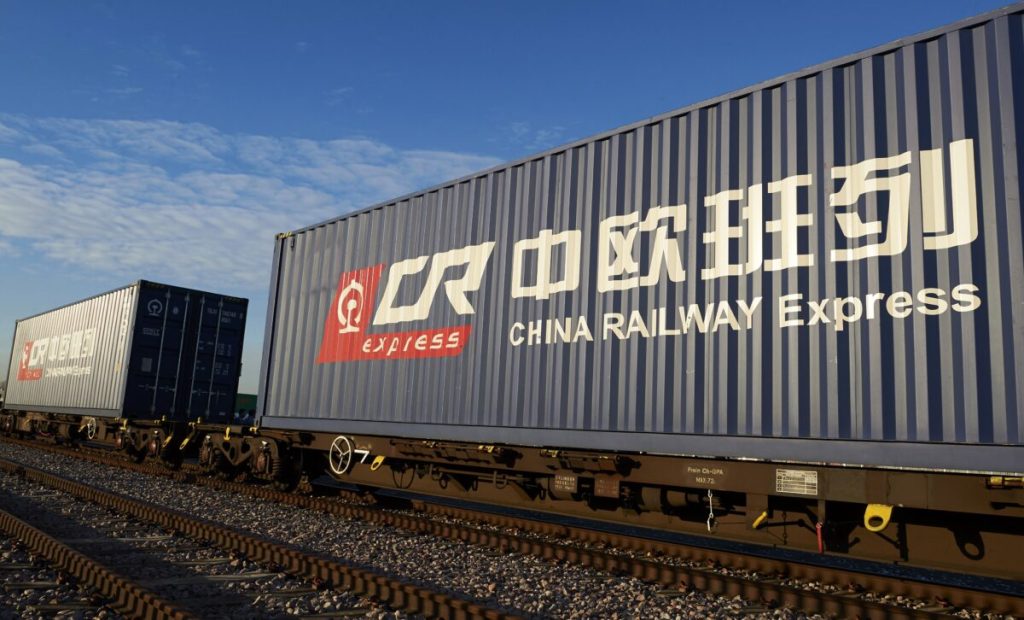

Xi Jinping emphasized the need to adhere to the principles of consultation, joint construction, and shared benefits to promote the development of China-Europe freight trains toward higher quality, better efficiency, and greater safety. The China-Europe freight trains have been in operation for more than a decade, exceeding 100,000 trips in total. This has strongly supported the stability of international industrial and supply chains and established a new framework for Asia-Europe international transportation and trade exchanges.
Recently, the 10th anniversary of the Yiwu-China-Europe freight train, the longest domestic freight train route in China, was celebrated. This route has transported over 670,000 standard containers in total, significantly contributing to Yiwu’s role as the “World Supermarket” and its prominence as a global trade hub. Over more than ten years, the annual trips of the China-Europe freight trains have increased from 80 one-way trips in 2013 to 17,000 two-way trips in 2023. This has formed a network of three main corridors—Western, Central, and Eastern—along with six major border ports, connecting 125 cities in China with 227 cities in 25 European countries. This network now covers nearly the entirety of the Eurasian continent.
In his keynote speech at the Third Belt and Road International Cooperation Forum, Xi Jinping announced that China would accelerate the high-quality development of the China-Europe freight trains and participate in constructing the international transport corridor via the Caspian Sea. During a general meeting of the Communist Party of China, calls were made to build a higher-level open economic system and improve mechanisms for advancing the high-quality development of the Belt and Road Initiative. This year, the China-Europe freight trains have expedited the construction of an efficient transportation system, a secure management system, a diversified route system, and an innovative development system, continuously enhancing their operational quality and efficiency.
The China-Europe freight trains are also fostering economic growth along their routes. Numerous new logistics hubs, trade zones, and industrial parks have emerged along these routes, creating new employment opportunities for local residents. In September, the first China-Europe freight train assembly hub in Central and Eastern Europe was established in Serbia. Meanwhile, logistics enterprises at Duisburg Port in Germany have generated over 20,000 local jobs.
The increasingly efficient China-Europe freight trains are transforming more inland cities into new focal points for opening up, while establishing new platforms for trade and economic cooperation along their routes. From January to October this year, the China-Europe freight trains completed 16,389 trips, marking a 13% annual increase. The annual value of goods transported via the trains has risen from $80 billion in 2016, when the unified brand was introduced, to $567 billion last year, with a cumulative total exceeding $4.2 trillion.